
Do not focus only on the advertised price
An attractive offer does not always mean a one-time purchase. Some promotions use a negative-option arrangement: if you do not decline or cancel in time, the merchant may treat this as acceptance of later charges, renewals, or deliveries. This can appear in free trials, automatic-delivery plans, introductory pricing, and automatic renewals.
Before adding a product to your cart, look for wording that indicates an ongoing arrangement. Examples include “subscribe,” “automatic deliveries,” “automatic renewal,” “free trial,” “introductory price,” “every month,” “every X weeks,” and “until you cancel.” These terms do not necessarily mean that the offer is unsuitable, but they do mean you should read the full terms before proceeding.
A free trial should not be interpreted as involving no commitment. If the site requests a card, it may charge you when the trial period ends unless you cancel beforehand. In addition, an offer with shipping costs or other fees is not entirely free.
- Treat any promotion as potentially recurring until the page clearly confirms that it is a one-time purchase.
- Read the text near the price, the purchase-option selector, and the button for adding the item—not just the promotional headline.
Confirm the selected option before clicking the button
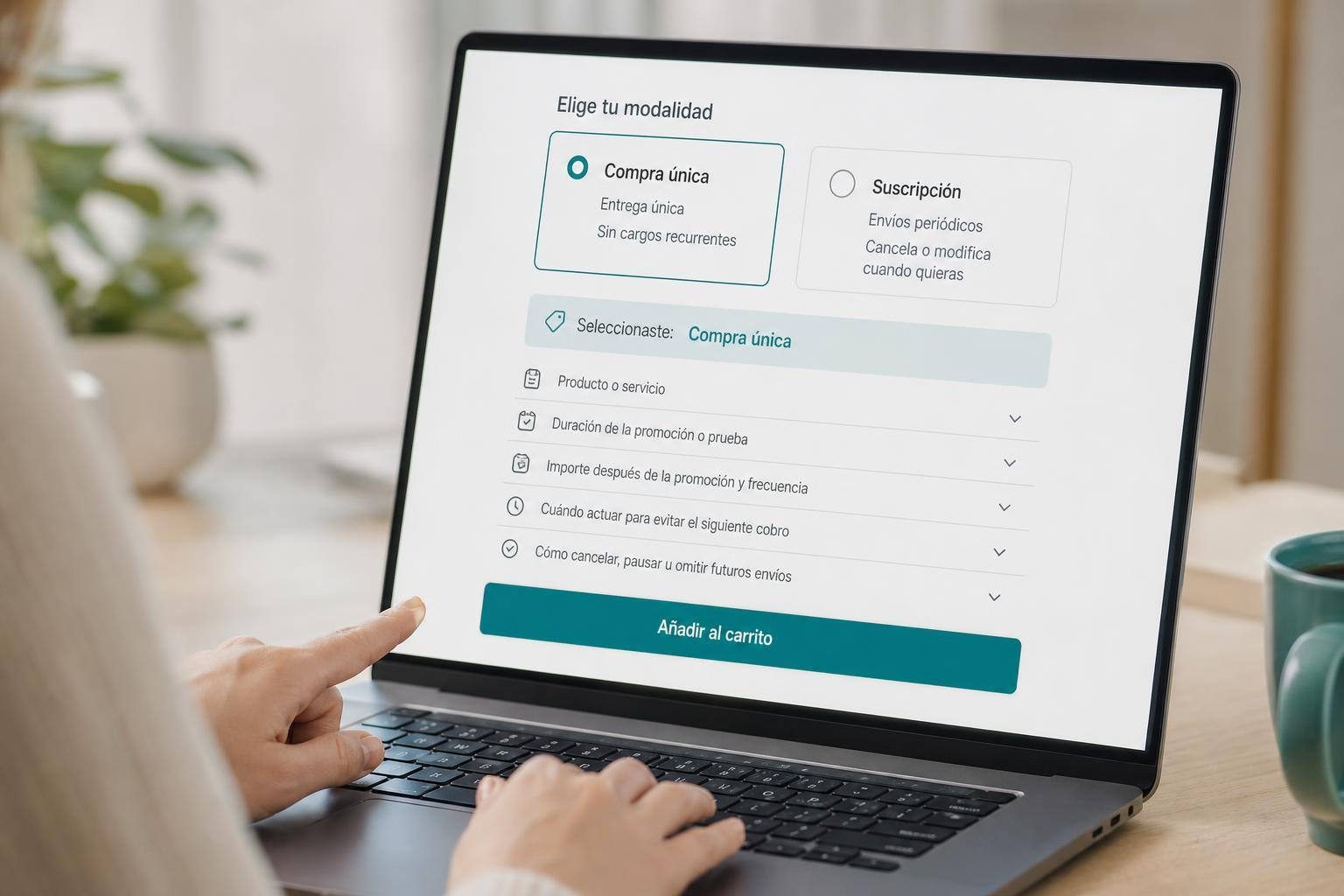
When a page shows several options, identify which one is currently active. There may be a “one-time purchase” or “one-time delivery” alternative alongside a subscription or recurring-delivery option. Do not assume that the main button adds the non-recurring option: check the selection immediately before adding it to your cart.
The essential check is to answer five questions. You should know which product or service you are accepting, how long the promotion or trial lasts, what amount will be charged afterward and how often, when you would need to act to avoid the next charge, and how you could cancel, pause, skip, or change future deliveries if those options exist.
A lack of clarity alone does not prove that there is a subscription, but it is a prudent reason to stop. If you cannot determine the arrangement, future amount, frequency, start of charges, or cancellation method, do not add the offer to your cart until you clarify it.
- Look for an explicit label such as “one-time purchase” or “one-time delivery” and make sure it is the selected option.
- If there is an introductory price, find the price that would apply after the promotion and the date when it would change.
Review checkboxes, fine print, and the cart summary
Important terms may appear outside the main description. Review preselected checkboxes, links to terms, pop-up windows, and additional lines in the cart. A preselected checkbox may authorize later charges, additional products, or uses of data that you did not expect. If you do not agree with what it says, uncheck it and review the order summary again.
Pay close attention to information shown in less visible places. Warning signs include the recurring price, frequency, or cancellation deadline appearing only in fine print, behind links, or not appearing at all. It is also wise to be cautious of ambiguous buttons, such as “continue” or “get offer,” when they do not explain the related commitment.
Do a final reading of the purchase panel before continuing. Check the name of the selected option, the delivery or billing frequency, the price after a promotion, and every line added to the order. This review helps distinguish a one-time discount from an ongoing arrangement.
- Uncheck any box whose terms you do not wish to accept, then review the cart again afterward.
- Save a screenshot of the product page and cart when they clearly show the option and relevant terms.

Assess whether cancellation is explained specifically
A recurring offer should allow you to understand how to stop future charges or deliveries before providing payment details. Check whether cancellation is done through your account, a form, phone, chat, or email, and find the applicable deadline. Knowing only that “you can cancel” is not enough if the site does not explain the procedure or when you need to do it.
If you decide to enroll in a trial or promotion with an ongoing arrangement, note the cancellation deadline and review your account statements for unexpected charges. This precaution is useful because an automatic renewal may apply a price different from the initial promotional price.
Specific legal obligations may vary depending on the jurisdiction, type of sale, and method used. As a practical purchasing criterion, prioritize transparency: if the merchant does not clearly explain ongoing billing or makes it difficult to learn how to cancel, it is better not to proceed until you have sufficient information.
- Before providing a card, find the cancellation method and the deadline for avoiding the next charge.
- Write down the end date of a trial and review activity in your account afterward.
Sources and references
- Getting In and Out of Free Trials, Auto-Renewals, and Negative Option Subscriptions | Consumer Advice ↗
- Click to Cancel: The FTC’s amended Negative Option Rule and what it means for your business | Federal Trade Commission ↗
- FTC to Ramp up Enforcement against Illegal Dark Patterns that Trick or Trap Consumers into Subscriptions | Federal Trade Commission ↗